Who Really Sets the Price of Commodities? The Market Forces Every Investor Needs to Understand
Posted on
Start Investing
Posted at
What Is a Commodity Price, and Why Should Investors Care?
Commodity price drivers are the economic, geopolitical, and financial forces that determine how much a raw material costs at any given moment. Understanding these forces is not just academic, it is a prerequisite for intelligent investing in energy, metals, agriculture, and the companies that depend on them.
Every time you fill up a car, buy a loaf of bread, or review an energy company's earnings report, you are seeing the downstream effects of commodity pricing at work. Yet most investors treat commodity prices as an unpredictable black box, reacting to them rather than anticipating them.
The truth is more structured. Commodity prices do not emerge from chaos. They are the outcome of competing forces that can be studied, modeled, and, with discipline, partially anticipated. For investors at Stock Profit Club, mastering these forces can make the difference between riding a commodity super-cycle and being caught on the wrong side of a trade.
This article breaks down exactly who and what sets commodity prices, from the physical supply chains to the speculative futures markets, the macroeconomic levers to the geopolitical disruptions. By the end, you will have a clear framework for interpreting price movements in any commodity market.
The Five Core Forces That Drive Commodity Prices
No single entity "sets" a commodity price the way a retailer sets a shelf price. Instead, commodity prices emerge from the interaction of five distinct forces. Each operates on a different time horizon and with a different degree of predictability. Skilled investors learn to weigh all five simultaneously.
Force 1: Physical Supply, Production Capacity, and Inventories
At the most fundamental level, commodity prices are anchored by physical reality. How much of a commodity can be extracted, grown, or refined, and how much is currently sitting in storage, are the bedrock variables every price discovery process begins with.
For oil, the OPEC+ production quota is the single most powerful supply lever in existence. When Saudi Arabia and Russia agree to cut output by 1 million barrels per day, global Brent crude prices typically respond within hours. For agricultural commodities, it is weather, not cartels, that governs supply. A drought in the Brazilian coffee belt or a freeze in the U.S. corn belt can move prices 10 to 20 percent in a single week.
Key supply-side signals investors should monitor include:
OPEC+ monthly production reports and compliance data
USDA crop production estimates and planting intention surveys
Weekly EIA crude oil inventory reports (U.S.)
London Metal Exchange (LME) warehouse stock reports for base metals
World Gold Council quarterly demand and supply data
Force 2: Global Demand, Industrial Cycles, and Emerging Markets
Supply tells you how much is available. Demand tells you how urgently buyers need it. The interplay between the two creates the price.
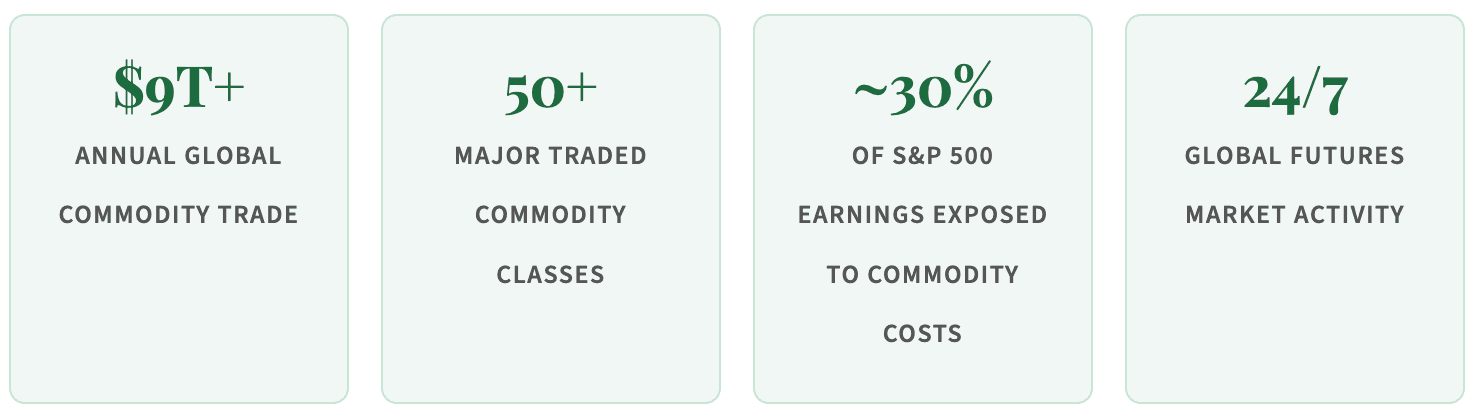
China is the single largest variable on the demand side for most industrial commodities. It accounts for roughly 55 percent of global copper consumption, over 50 percent of iron ore demand, and approximately 15 percent of global crude oil imports. When China's manufacturing PMI accelerates, base metal prices typically follow. When Chinese property developers enter a credit crisis, iron ore and steel markets feel it within weeks.
Beyond China, the global energy transition is creating entirely new demand curves. Lithium, cobalt, nickel, and copper are seeing structural demand growth from electric vehicle production and grid-scale battery storage, demand that did not meaningfully exist a decade ago. Investors who understand these secular demand shifts are positioned to identify commodity bull markets before they peak.
"China's industrial cycle is the closest thing commodity markets have to a single demand governor. When Beijing stimulates, raw material prices rise. When Beijing tightens, they fall."
Force 3: Futures Markets, Speculation, and Price Discovery
This is where commodity pricing gets misunderstood. Physical supply and demand set the long-run equilibrium price. But in the short to medium term, futures markets, and the speculative capital flowing through them, are a dominant commodity price driver.
Commodity futures are standardized contracts to buy or sell a set quantity of a commodity at a fixed price on a future date. They trade on exchanges including the CME Group (Chicago), ICE (Atlanta and London), the LME, and the SHFE (Shanghai). These markets serve two distinct populations: hedgers (producers and consumers locking in prices to manage risk) and speculators (financial participants seeking profit from price movements).
The Commitments of Traders (COT) report, published weekly by the U.S. CFTC, reveals the net positioning of different market participants. When large speculators ("managed money") build extreme long or short positions, it often signals a mean-reversion risk. Watching COT data is one of the most underused tools available to retail commodity investors.
Table 1: Major Global Commodity Exchanges and Their Key Markets
Exchange | Location | Key Commodity Markets | Daily Volume (approx.) |
|---|---|---|---|
CME Group | Chicago, USA | WTI crude, natural gas, gold, corn, wheat, soybeans | 25M+ contracts |
ICE | Atlanta / London | Brent crude, natural gas, cocoa, sugar, coffee | 10M+ contracts |
LME | London, UK | Copper, aluminum, zinc, nickel, lead, tin | $50B+ daily |
SHFE | Shanghai, China | Copper, aluminum, zinc, gold, crude oil | Largest by volume |
TOCOM | Tokyo, Japan | Gold, silver, rubber, platinum | Regional focus |
NYMEX | New York, USA | WTI crude, gasoline, heating oil, natural gas | Part of CME Group |
Force 4: Geopolitics, Sanctions, and Supply Chain Disruptions
Geopolitical risk is the wildcard force. It can override rational price discovery in a matter of hours. The 2022 Russian invasion of Ukraine sent European natural gas prices to levels 10 times above their historical average. The 2019 drone attack on Saudi Aramco's Abqaiq facility caused a 15 percent single-day spike in crude oil prices, the largest in history.
Geopolitical commodity price drivers typically manifest as: supply route disruptions (Strait of Hormuz, Suez Canal, Black Sea), export sanctions on major producing nations, nationalization of mining or oil assets, trade disputes and tariffs on commodity-related goods, and political instability in resource-rich nations.
Unlike supply-demand fundamentals, geopolitical shocks are by definition difficult to predict. However, investors can prepare by understanding which commodities are most geopolitically concentrated. When more than 40 percent of a commodity's global supply originates from one or two nations, the geopolitical risk premium embedded in its price is structurally higher.
Force 5: Currency Movements, Inflation, and Central Bank Policy
Most globally traded commodities are priced in U.S. dollars. This creates an inverse mechanical relationship: when the U.S. dollar strengthens, commodities become more expensive in local currencies worldwide, typically suppressing demand and pushing prices lower. When the dollar weakens, the opposite occurs.
This is why the Federal Reserve's interest rate decisions are a commodity price driver that every investor should monitor. Rate hikes strengthen the dollar, compress commodity prices, and reduce the appeal of non-yielding commodities like gold. Rate cuts do the reverse.
Gold, in particular, functions as an inflation hedge and a dollar alternative. During periods of high real inflation (inflation minus interest rates), gold tends to outperform. Understanding this relationship allows investors to use gold price signals as a macroeconomic indicator, not just a commodity trade.
How Price-Setting Works Across Different Commodity Classes
While the five forces apply universally, their relative weight varies dramatically across commodity classes. A copper mine operator faces a very different pricing environment than a wheat farmer or an oil producer. Investors benefit from understanding the dominant pricing mechanism for each asset class they follow.
Energy: OPEC, Shale, and the Demand Cycle
Crude oil is the world's most traded commodity and its pricing is the most geopolitically complex. The Brent crude benchmark (North Sea) and WTI (West Texas Intermediate) serve as reference prices for the majority of global oil contracts. These benchmarks are set through continuous futures market trading, but they are heavily influenced by OPEC+ production decisions, U.S. shale output growth, and global GDP-linked demand.
Natural gas pricing is more regionally fragmented. U.S. natural gas (Henry Hub) trades at very different levels from European TTF or Asian LNG spot prices, reflecting infrastructure constraints, liquefaction capacity, and local supply-demand balances.
Precious Metals: Central Banks and Safe-Haven Flows
Gold is unique because its industrial demand is relatively small (approximately 7 to 10 percent of total demand). The majority of gold demand comes from investment (ETFs, coins, bars), jewelry, and central bank purchases. This makes gold pricing more sensitive to monetary policy, real interest rates, and risk appetite than to industrial cycles.
Central bank gold buying has surged in recent years as nations seek to diversify foreign reserves away from the U.S. dollar. This structural shift is itself a commodity price driver that has put a meaningful floor under gold prices in the post-2022 era.
Silver occupies a middle ground, with roughly half its demand being industrial (solar panels, electronics, medical) and half investment-driven. This dual nature makes silver more volatile than gold and sensitive to both the industrial cycle and monetary conditions simultaneously.
Base Metals: China, the Energy Transition, and Mining Costs
Copper is the most economically sensitive metal. Its price correlation with global manufacturing activity and construction spending has earned it the informal title of "Dr. Copper," the metal with a PhD in economics. The LME copper price is the global benchmark, with the SHFE copper price in Shanghai increasingly important as China's market influence grows.
For base metals, production costs set a long-run price floor. If copper falls below the all-in sustaining cost (AISC) of the marginal producer, mines eventually curtail output, which reduces supply until prices recover. Understanding AISC for key metals is an essential tool for identifying long-term value in the commodity cycle.
Agriculture: Weather, Policy, and the Food-Energy-Water Nexus
Agricultural commodity prices are set by a combination of weather patterns, government policy (subsidies, export restrictions, strategic reserves), planting decisions by millions of individual farmers, and increasingly, biofuel mandates that link food prices to energy prices.
The USDA World Agricultural Supply and Demand Estimates (WASDE) report, published monthly, is the single most important scheduled data release for agricultural commodity traders. It functions in agricultural markets similarly to how the OPEC meeting functions in oil markets.
Table 2: Dominant Commodity Price Drivers by Asset Class
Commodity Class | Primary Price Driver | Secondary Driver | Key Data Release | Price Benchmark |
|---|---|---|---|---|
Crude Oil | OPEC+ production policy | U.S. shale output growth | EIA Weekly Inventory | Brent / WTI |
Natural Gas | Weather / seasonal demand | LNG export capacity | EIA Gas Storage | Henry Hub / TTF |
Gold | Real interest rates / USD | Central bank buying | Fed policy decisions | LBMA spot / COMEX |
Silver | Industrial demand cycle | Gold-silver ratio speculation | Solar installation data | LBMA spot |
Copper | China manufacturing PMI | EV / grid infrastructure demand | LME warehouse stocks | LME 3-month |
Wheat / Corn | Weather and crop yields | Export policy decisions | USDA WASDE (monthly) | CBOT futures |
Coffee / Cocoa | Weather in Brazil / Ivory Coast | Currency (BRL, CFA) | ICE warehouse stocks | ICE Arabica / Cocoa |
How Investors Should Evaluate Commodity Exposure: Valuation and Risk Framework
Unlike equities, commodities do not have earnings, dividends, or book values. Valuing commodity exposure requires a different framework, one based on cost curves, supply-demand balances, and risk-adjusted return scenarios relative to price cycles.
Investors accessing commodity exposure through equities (miners, energy producers, agricultural businesses) benefit from an additional valuation layer: the leverage effect. A copper miner with a cash cost of $2.50 per pound and a copper price at $4.00 per pound earns $1.50 per pound in margin. If copper rises to $4.50 per pound, revenues are up 12.5 percent but margins are up 33 percent. This asymmetric leverage is why commodity equities can dramatically outperform the underlying commodity in a bull market, and underperform in a bear market.
Table 3: Commodity Equity Valuation Framework (Copper Example)
Copper Price Scenario | Revenue/lb (Miner) | Cash Cost/lb | Margin/lb | Equity Impact | Signal |
|---|---|---|---|---|---|
Bear: $3.00/lb | $3.00 | $2.50 | $0.50 | Margin compression 67% | Bearish |
Base: $4.00/lb | $4.00 | $2.50 | $1.50 | Baseline assumption | Neutral |
Bull: $4.75/lb | $4.75 | $2.50 | $2.25 | Margin expansion 50% | Bullish |
Super-cycle: $6.00/lb | $6.00 | $2.60 | $3.40 | Margin expansion 127% | Strong Buy |
The Commodity Risk Matrix
Every commodity investment carries a distinct risk profile. The table below summarizes the key risk categories and their severity across major commodity classes. Investors should calibrate position sizing based on these risk factors relative to their portfolio construction goals. The resources and analysis available at Stock Profit Club provide ongoing coverage of these risk shifts as market conditions evolve.
Table 4: Commodity Investment Risk Matrix
Risk Factor | Oil / Gas | Gold / Silver | Base Metals | Agriculture |
|---|---|---|---|---|
Geopolitical Risk | High | Medium | Medium | Medium |
Weather / Climate Risk | Low | Low | Low | High |
Currency (USD) Risk | High | High | Medium | Medium |
Demand Cycle Risk | High | Low | High | Medium |
Speculative Volatility | High | High | Medium | Medium |
Regulatory / Policy Risk | High | Low | Medium | High |
Structural Demand Shift | High (EV/transition) | Medium | Positive (EV) | Medium |
Key Concept: The Commodity Super-Cycle
A commodity super-cycle is a prolonged period (typically 15 to 30 years) of above-trend commodity prices driven by a structural shift in demand. The most recent super-cycle was driven by China's industrialization from roughly 2000 to 2011. Many analysts argue that the energy transition, specifically the buildout of clean energy infrastructure globally, is the catalyst for the next one, with copper, lithium, and nickel as potential long-run beneficiaries.
A Strategic Framework for the Commodity-Aware Investor
No single entity sets commodity prices. The price of oil at any given moment is the aggregate output of OPEC policy decisions, U.S. shale producer economics, Chinese demand signals, speculative futures positioning, and the prevailing level of the U.S. dollar. The price of wheat reflects Brazilian weather, Ukrainian export capacity, global food inventories, and the energy costs of fertilizer production. The price of copper distills global manufacturing health, Chinese property sector conditions, and the pace of the energy transition into a single number that updates every second.
For investors, this complexity is not a barrier. It is an opportunity. Markets are inefficient when complexity obscures value. Investors who build a systematic understanding of commodity price drivers, who monitor the right data releases, who understand the leverage dynamics of commodity equities, and who maintain a risk framework calibrated to the unique volatility of each commodity class, are consistently better positioned than those who react to headlines.
★ Strategic Investor Takeaway
The most important insight for commodity investors is this: physical fundamentals set the long-run price anchor, but futures market positioning and macro conditions drive short-term price action. The most profitable trades typically occur when short-term sentiment is negative (and speculative positioning is extreme short) while long-run fundamentals are turning positive. Identifying these divergences, particularly in copper, oil, and gold, is where patient, research-driven investors generate asymmetric returns.
Monitor your commodity price drivers systematically, not reactively. Track OPEC, the WASDE report, LME warehouse stocks, China PMI, COT positioning, and Fed policy in an integrated dashboard. Build positions when supply-demand fundamentals are constructive, not when headlines are already positive. And always size positions relative to the risk matrix for that specific commodity class.