Options Trading: A Step-by-Step Guide for Beginners Who Want an Edge
Posted on
Start Trading
Posted at
Why Options Trading Matters for Every Investor
Most people learn to invest by buying stocks and waiting. That approach works, but it leaves a significant toolkit untouched. Options trading for beginners opens up an entirely different dimension of the market, one where investors can profit in rising, falling, or even flat conditions, hedge existing positions, and control large notional value with limited capital.
Options are not the exotic, reckless instruments that popular culture often portrays. When understood properly, they are precise financial tools used by individual investors, hedge funds, and corporate treasuries alike. The challenge is not that options are inherently complex, but that most beginner resources are either too technical or too shallow to be practically useful.
This guide changes that. Over five structured sections, you will build a complete foundation in options trading, from the core vocabulary and mechanics, through practical strategies, to risk management and how to place your first trade. Each section is designed to be immediately actionable, grounded in real market data, and free from unnecessary jargon.
Definition
Options trading is the buying and selling of contracts that give the holder the right, but not the obligation, to buy or sell an underlying asset at a specified price (the strike price) before or on a specified expiration date. Options are derivatives, meaning their value is derived from an underlying asset such as a stock, ETF, or index.
Whether your goal is generating income on stocks you already own, speculating on short-term price moves, or protecting a long-term portfolio from downturns, options have a role to play. Let us start from the very beginning.
Core Concepts: The Building Blocks of Every Options Trade
Before placing a single trade, you must understand the fundamental vocabulary of options. These are not abstract academic terms. They are the precise language of every contract you will ever buy or sell.
Calls and Puts: The Two Types of Options
Every options contract is either a call or a put. Understanding the difference is the most important first step.
Call Option: Gives the buyer the right to purchase 100 shares of the underlying stock at the strike price before expiration. Buyers of calls are bullish, expecting the stock to rise.
Put Option: Gives the buyer the right to sell 100 shares of the underlying stock at the strike price before expiration. Buyers of puts are bearish, expecting the stock to fall.
Each contract typically represents 100 shares. If you buy one call option at a premium of $3.00, you are paying $300 in total (100 shares x $3.00).
Key Terms Every Beginner Must Know
Table 1: Essential Options Terminology
Term | Definition | Why It Matters |
|---|---|---|
Premium | The price paid by the buyer to the seller for the option contract | Your maximum loss when buying options |
Strike Price | The fixed price at which the option can be exercised | Determines if and when the option has intrinsic value |
Expiration Date | The date on which the option contract expires and becomes worthless if not exercised | Time decay accelerates as expiration approaches |
In the Money (ITM) | A call is ITM when stock price is above the strike; a put is ITM when stock price is below the strike | ITM options have intrinsic value and higher premiums |
Out of the Money (OTM) | A call is OTM when stock price is below the strike; a put is OTM when stock price is above the strike | OTM options are cheaper but require a larger price move to profit |
At the Money (ATM) | When the stock price is approximately equal to the strike price | ATM options have the highest time value |
Implied Volatility (IV) | The market's forecast of how much the underlying stock will move, expressed as an annualized percentage | Higher IV means more expensive premiums |
The Greeks | Delta, Gamma, Theta, Vega: measures of an option's sensitivity to various factors | Critical for understanding how your position will behave |
The Greeks: A Practical Introduction
The Greeks are the sensitivities of an option's price to market conditions. For beginners, understanding Delta and Theta is sufficient to start trading intelligently.
Delta: How much the option price moves for every $1 move in the underlying stock. A delta of 0.50 means the option gains $0.50 for every $1 the stock rises. Call options have positive delta (0 to 1), put options have negative delta (0 to -1).
Theta: The rate at which an option loses value as time passes, often called time decay. Every day that passes, especially close to expiration, an option loses some of its value purely due to the passage of time, even if the stock does not move.
Vega: How much the option price changes when implied volatility moves by 1%. A long option position benefits from rising volatility.
Gamma: The rate of change of delta. It measures how quickly delta itself changes as the stock moves.
Key Insight
Theta works against option buyers and in favor of option sellers. If you buy an OTM option and the stock does not move, you lose money every day simply due to time passing. This is one reason experienced traders are often net sellers of options.
Beginner Options Strategies: From Simple to Structured
The most common mistake beginners make is jumping straight into complex multi-leg strategies before mastering the fundamentals. The four strategies below are ordered by complexity and are the ideal progression for any new options trader.
Strategy 1: Buying Calls (Bullish Speculation)
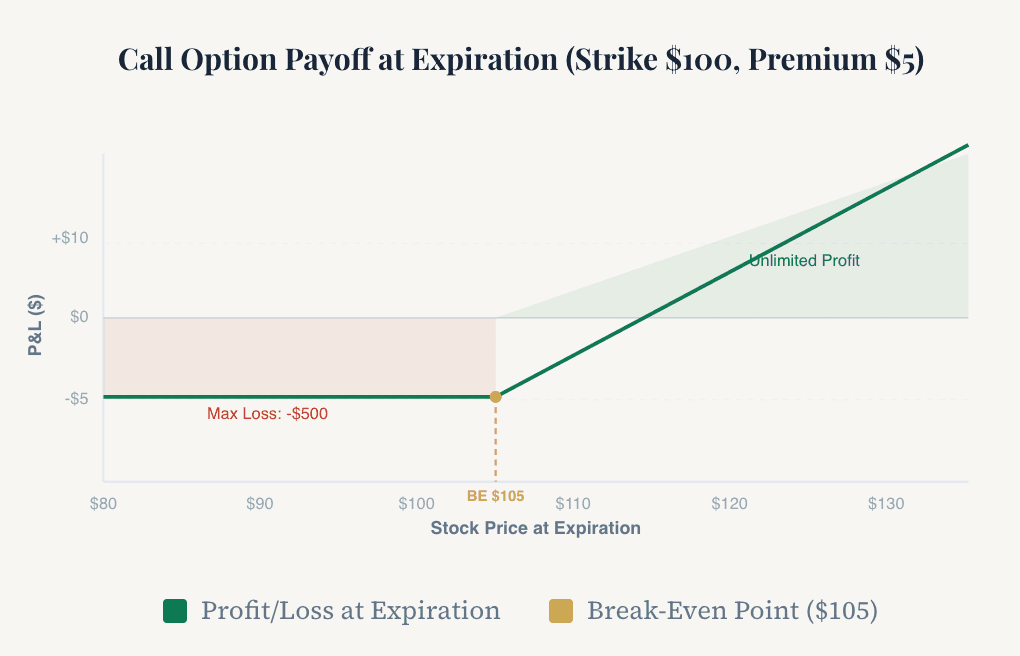
Buying a call option is the simplest bullish bet. If you believe a stock will rise significantly before expiration, buying a call lets you control 100 shares for a fraction of the cost of buying the stock outright.
When to use: You expect the stock to rise meaningfully before expiration.
Maximum loss: The premium paid.
Maximum gain: Theoretically unlimited (the higher the stock rises, the more your call is worth).
Break-even: Strike price + premium paid
Example
Stock XYZ trades at $100. You buy a $105 call expiring in 30 days for a $3 premium ($300 total). If XYZ rises to $115, your option is worth at least $10, giving you a $700 profit on a $300 investment. If XYZ stays below $105, you lose the $300 premium.
Strategy 2: Buying Puts (Bearish Speculation or Hedging)
Buying a put is the mirror image of buying a call. It profits when a stock falls. Puts are also used as portfolio insurance, protecting a long stock position against a significant decline.
When to use: You expect the stock to fall, or you want to protect an existing long position.
Maximum loss: The premium paid.
Maximum gain: The strike price minus zero (substantial, but not unlimited).
Strategy 3: Covered Calls (Income Generation)
The covered call is the most popular strategy for stock investors transitioning into options. If you already own 100 shares of a stock, you can sell a call option against those shares and collect the premium as income.
When to use: You own the stock, expect it to trade flat or rise modestly, and want to generate extra income.
Maximum gain: The premium received, plus the difference between your stock purchase price and the strike price.
Risk: If the stock drops sharply, the premium only partially offsets your loss on the shares.
Strategy 4: Cash-Secured Puts (Acquiring Stock at a Discount)
Selling a cash-secured put means you agree to buy 100 shares of a stock at the strike price if the stock falls below it, in exchange for receiving the option premium upfront. This is an ideal strategy for investors who want to own a stock but prefer to buy it at a lower price.
When to use: You want to own a stock at a lower price and are happy to collect premium while you wait.
Maximum gain: The premium received.
Risk: You may be obligated to buy the stock at the strike price, which could be above the current market price if the stock falls sharply.
Table 2: Beginner Options Strategies Comparison
Strategy | Direction | Max Gain | Max Loss | Capital Required | Best For |
|---|---|---|---|---|---|
Buy Call | Bullish | Unlimited | Premium paid | Low | Speculative upside |
Buy Put | Bearish | Strike - Zero | Premium paid | Low | Hedging or speculation |
Covered Call | Neutral/Mild Bull | Premium + upside to strike | Stock falls to zero minus premium | High (own stock) | Income on existing holdings |
Cash-Secured Put | Neutral/Mild Bull | Premium received | Strike price minus premium | Medium (cash reserve) | Buying stock at a discount |
How to Trade Options Without Blowing Up Your Account
Options are powerful precisely because of their leverage. A stock that rises 5% might cause an option to gain 50% or more. But that leverage cuts in both directions. Without disciplined risk management, even a series of correct directional calls can result in net losses due to poor sizing, timing, or volatility mispricing.
The Core Rules of Options Risk Management
Risk only what you can afford to lose on any single trade. Most professional traders risk no more than 1 to 3% of their total portfolio on a single options position.
Understand your maximum loss before you enter. Unlike stocks, many options positions have clearly defined maximum losses (the premium paid). Know this number before the trade is placed.
Respect time decay. If you buy options, give yourself enough time for your thesis to play out. Buying options that expire in one week is a high-risk approach. 30 to 60 days to expiration is a common starting point for beginners.
Do not fight implied volatility. Buying options when IV is extremely high means you are paying a premium for volatility that may not materialize. Use an IV percentile indicator to assess whether current IV is high or low relative to historical levels.
Have a clear exit plan. Define your profit target and your maximum acceptable loss before entering. Many traders use a rule such as: take profit at 50% gain, and cut losses if the option loses 50% of its value.
The Most Common Beginner Mistakes
The most common reason beginners lose money in options is not incorrect direction calls. It is buying OTM options with very short expiration dates, where time decay destroys the position even if the stock moves in the right direction.
Table 3: Options Risk Assessment Framework
Risk Factor | Description | Risk Level | Mitigation Strategy |
|---|---|---|---|
Time Decay (Theta) | Option loses value each day, especially near expiration | High | Use longer-dated options (30-60+ DTE) |
IV Crush | Options bought before a high-IV event (earnings) often lose value after the event even if the stock moves in the right direction | High | Avoid buying options immediately before earnings |
Position Sizing | Over-allocating to options positions due to their low nominal cost | High | Limit each position to 1-3% of portfolio |
Assignment Risk | When selling options, you may be assigned shares unexpectedly | Medium | Ensure you have capital or shares to fulfill obligation |
Liquidity Risk | Wide bid-ask spreads in thinly traded options can cause significant slippage | Medium | Trade options on high-volume stocks (SPY, AAPL, MSFT) |
Directional Risk | Incorrect view on stock direction causes option to expire worthless | Medium | Use defined-risk spreads instead of naked long options |
Early Exercise | American-style options can be exercised at any time before expiration | Low | Monitor positions with deep ITM short options |
Implied Volatility and Pricing: What Beginners Overlook
Implied volatility (IV) is embedded in every option's price. When IV is elevated, options are expensive. When IV is compressed, options are cheap. A practical starting point is to check the IV Rank (IVR) before trading, which measures current IV relative to its 52-week range on a scale of 0 to 100.
IVR above 50: Options are relatively expensive. Strategies that sell premium (covered calls, cash-secured puts) are more attractive.
IVR below 30: Options are relatively cheap. Strategies that buy premium (long calls, long puts) offer better value.
For more detailed analysis of market conditions and how they affect options pricing, the team at Stock Profit Club publishes regular volatility assessments and trade ideas to help members navigate changing market environments.
Placing Your First Trade and Building a Long-Term Edge
You now have the conceptual foundation that most beginner guides skip over or bury in jargon. Let us translate it into a concrete, step-by-step process for executing your first options trade.
Step-by-Step: Your First Options Trade
Choose a broker with options approval. Most major platforms (TD Ameritrade/Thinkorswim, Interactive Brokers, Tastytrade, Robinhood) offer options trading. You will need to apply for options approval, typically Level 1 or Level 2 for beginners, which covers buying calls and puts and covered calls.
Select a liquid underlying asset. Start with high-volume ETFs or large-cap stocks where bid-ask spreads are tight. SPY (S&P 500 ETF), QQQ (Nasdaq ETF), AAPL, and MSFT are popular starting points because of their deep options markets.
Form a clear market thesis. Before looking at the options chain, decide: what is your directional view? What is your time horizon? How much are you willing to risk?
Open the options chain and select an expiration. For beginners, target expirations 30 to 60 days out. This gives your thesis time to develop while keeping the option affordable.
Choose a strike price. For buying calls or puts, starting with an ATM or slightly OTM strike (delta between 0.30 and 0.50) gives a balance between cost and probability of profit.
Check the bid-ask spread. The spread should be no more than 5 to 10% of the option's mid-price. If the spread is wider, the option is illiquid and should be avoided.
Calculate your total risk. Premium x 100 shares = your maximum loss. Ensure this is within your predetermined risk tolerance for a single position.
Place a limit order at or near the mid-price. Never use market orders for options. Always use limit orders, and start at the mid-price between the bid and the ask.
Set your exit levels. Before the trade is placed, decide: at what profit percentage will you close? At what loss percentage will you exit? Write this down.
Monitor and manage. Check your position regularly but not obsessively. For a 30-day option, daily monitoring is appropriate. Avoid making emotional decisions based on short-term fluctuations.
Building a Long-Term Edge in Options Trading
The difference between traders who consistently profit from options and those who do not comes down to three factors: discipline in position sizing, understanding of volatility dynamics, and continuous education.
Options are not a get-rich-quick vehicle. They are a precision instrument. Used conservatively, they can dramatically improve your portfolio's risk-adjusted returns. Used recklessly, they can erode capital quickly. The frameworks in this guide, internalized and practiced consistently, put you on the right side of that equation.
Strategic Investor Takeaway
Start with covered calls or cash-secured puts if you already own stocks. These strategies generate income with defined risk and give you practical experience with options mechanics without excessive speculation. As your confidence and understanding grow, expand into directional strategies with strict position sizing rules.
The options market rewards preparation, patience, and process. Every professional trader was once a beginner who committed to learning the craft systematically. The foundation you have built in this guide is a genuine starting point, not a shortcut, but a real edge if you apply it with consistency.
For ongoing trade ideas, strategy breakdowns, and market analysis tailored to active investors, visit Stock Profit Club, where expert content is published regularly to help you sharpen your approach to both options and equity investing.