What Is an Exchange-Traded Fund (ETF)?
Posted on
Start Investing
Posted at
Introduction to Exchange-Traded Funds
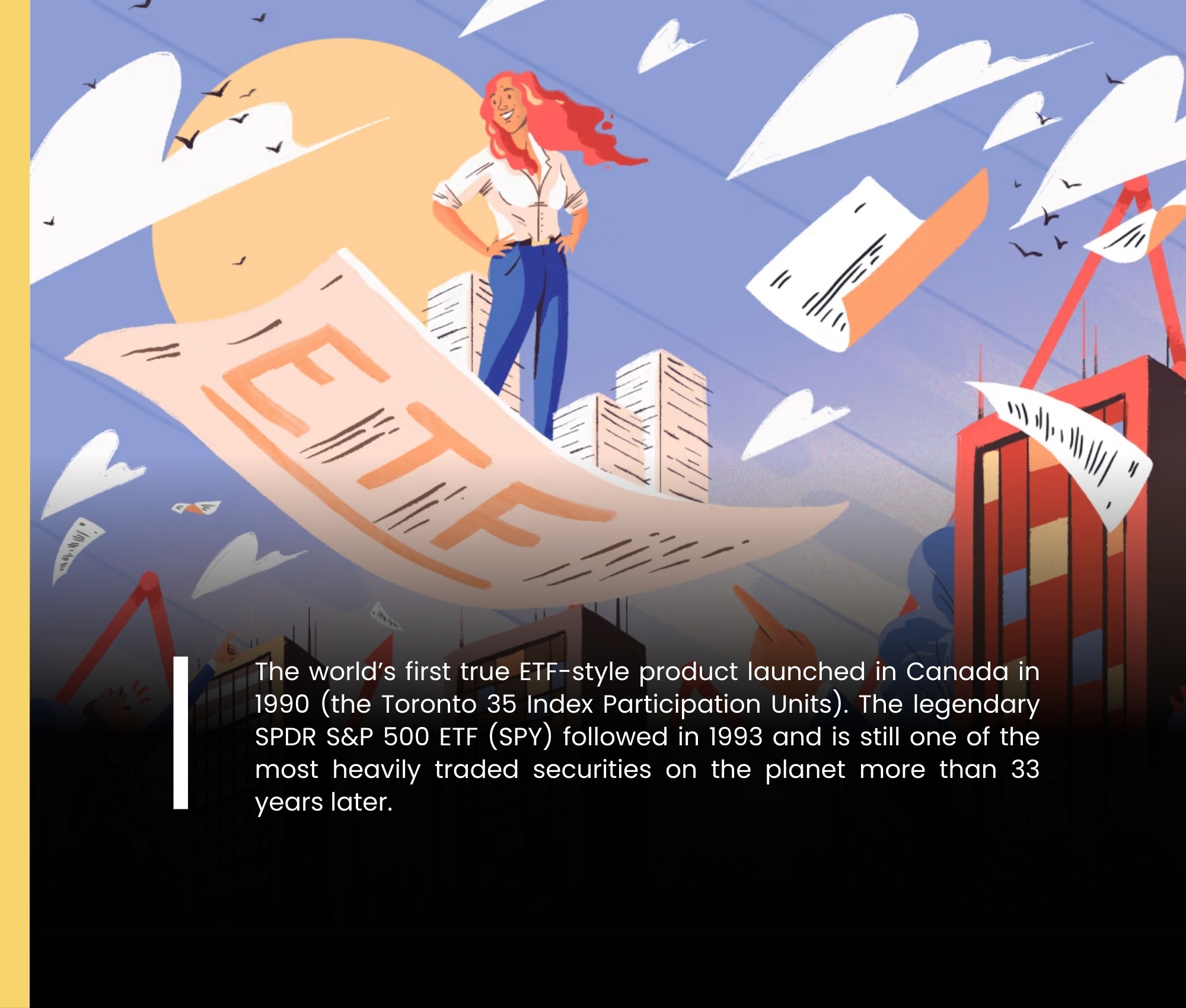
An exchange-traded fund, or ETF, is a pooled investment vehicle that holds a basket of assets such as stocks, bonds, commodities, or other securities and trades on major stock exchanges just like an individual share. Investors buy and sell ETF shares throughout the trading day at market prices that reflect real-time supply and demand, offering intraday liquidity unmatched by traditional mutual funds.
ETFs deliver instant diversification because one share represents ownership in dozens, hundreds, or even thousands of underlying holdings. This structure appeals to both beginners seeking broad market exposure and experienced investors building sophisticated portfolios. The term “exchange-traded fund” highlights two core advantages: exchange trading and fund-level diversification.
In 2026 the global ETF industry manages over $13 trillion in U.S. assets alone, up dramatically from just $3 trillion a decade earlier. This growth reflects investor demand for transparent, cost-efficient, and flexible vehicles that align with modern portfolio strategies.
ETFs track specific indexes, sectors, themes, or active strategies while maintaining low expense ratios, often below 0.10 percent for core offerings. They combine the best features of stocks and mutual funds without many of the drawbacks.
The History and Evolution of ETFs
The first U.S. ETF launched on January 22, 1993, when State Street Global Advisors introduced the SPDR S&P 500 ETF Trust, ticker SPY. Designed to track the S&P 500 Index, SPY revolutionized investing by letting ordinary investors own the 500 largest U.S. companies in a single, tradable security.
Before 1993, most retail investors relied on mutual funds with end-of-day pricing and higher fees. SPY changed the game by offering intraday trading, tax efficiency, and rock-bottom costs. Its success sparked an explosion of innovation.
By the early 2000s, sector ETFs, international funds, and bond ETFs entered the market. Vanguard launched its first ETF in 2004, bringing its low-cost philosophy to the space. Invesco QQQ, tracking the Nasdaq-100, gained popularity during the tech boom and remains a favorite for growth-oriented investors.
The 2010s saw the rise of smart-beta and factor ETFs that weight holdings by value, momentum, or quality rather than pure market cap. Actively managed ETFs also proliferated, allowing professional managers to pursue alpha inside the ETF wrapper.
By 2026 the industry has matured into a $13+ trillion powerhouse in the U.S. alone. New launches in 2025 exceeded 1,100, with active ETFs capturing a growing share of flows. Thematic ETFs focused on artificial intelligence, clean energy, and cybersecurity now attract billions in fresh capital.
How Exchange-Traded Funds Work
Understanding ETF mechanics reveals why they trade so efficiently and stay closely aligned with their underlying value. At the heart of every ETF lies the creation and redemption process managed by authorized participants, typically large financial institutions.
When demand for ETF shares rises, an authorized participant assembles the basket of underlying securities (or cash equivalent) and delivers it to the ETF issuer in exchange for new ETF shares. This “creation unit” is usually 50,000 shares or more. The reverse happens during redemption: the participant returns ETF shares and receives the underlying assets.
This in-kind mechanism keeps the ETF price tightly linked to its net asset value (NAV), the per-share value of the fund’s holdings. If the ETF trades at a premium to NAV, authorized participants create new shares to arbitrage the difference. Discounts trigger redemptions. The result is minimal deviation, usually just a few basis points.
ETFs publish their full holdings daily, unlike mutual funds that disclose quarterly. This transparency lets investors see exactly what they own at all times.
Dividends and interest from underlying securities flow into the fund and are distributed to shareholders, typically quarterly. Because of the creation-redemption process, ETFs rarely realize capital gains inside the fund, making them highly tax-efficient for taxable accounts.
Trading works exactly like stocks. Place limit or market orders during exchange hours. Bid-ask spreads on major ETFs like SPY or VOO are often just one cent. Even smaller or niche ETFs maintain reasonable liquidity thanks to the arbitrage mechanism.
Tracking error measures how closely an ETF follows its benchmark. Low-cost, high-volume ETFs like VOO typically show tracking error under 0.05 percent annually. Factors that influence tracking include expense ratios, dividend reinvestment timing, and sampling methods for indexes with thousands of holdings.
For investors, this structure delivers the liquidity of stocks with the diversification and cost structure of funds, a powerful combination that explains the dominance of ETFs in modern portfolios.
Types of Exchange-Traded Funds
The ETF universe offers remarkable variety. Broad-market equity ETFs provide core exposure, while specialized products target precise outcomes. Here are the major categories serious investors use in 2026.
Equity ETFs track stock indexes. Broad U.S. examples include VOO and IVV for the S&P 500, VTI for the total U.S. market, and QQQ for the Nasdaq-100 growth leaders. International equity ETFs cover developed or emerging markets, while sector ETFs focus on technology, healthcare, financials, or energy.
Bond or fixed-income ETFs hold government, corporate, municipal, or high-yield bonds. They offer regular income with varying duration and credit risk. Popular choices include funds tracking the Bloomberg U.S. Aggregate Bond Index.
Commodity ETFs provide exposure to gold, silver, oil, or agricultural products without owning physical assets directly. Some use futures contracts, others hold physical bullion like the SPDR Gold Shares (GLD).
Thematic and sector ETFs target megatrends such as artificial intelligence, cybersecurity, renewable energy, or aging populations. These often carry higher volatility but deliver outsized returns during favorable cycles.
Factor or smart-beta ETFs tilt toward value, momentum, low volatility, or quality stocks to potentially improve risk-adjusted returns.
Leveraged and inverse ETFs amplify daily moves (2x or 3x) or deliver opposite performance. These tools suit short-term tactical trades rather than long-term holding due to compounding effects.
Actively managed ETFs, now over 11 percent of total assets, let professional managers adjust holdings daily while retaining ETF benefits.
Benefits, Risks, and Strategic ETF Investing in 2026
Exchange-traded funds deliver multiple advantages that explain their popularity among retail and professional investors alike.
Key Benefits
Instant diversification across hundreds of securities in one trade.
Extremely low expense ratios, often 0.03 percent to 0.20 percent.
Intraday trading flexibility and high liquidity.
Superior tax efficiency via in-kind redemptions that minimize capital-gains distributions.
Full daily transparency of holdings.
Easy access to global markets, sectors, and themes that would be difficult or expensive to replicate individually.
Data tables illustrate these strengths clearly.
Table 1: Top 5 Largest ETFs by Assets Under Management (Early 2026 Data)
Ticker | ETF Name | AUM (approx.) | Expense Ratio | 2025 Return (approx.) | 5-Year Annualized Return (approx.) |
|---|---|---|---|---|---|
VOO | Vanguard S&P 500 ETF | $879 billion | 0.03% | 17.8% | 14.5% |
IVV | iShares Core S&P 500 ETF | $757 billion | 0.03% | 17.8% | 14.5% |
SPY | SPDR S&P 500 ETF Trust | $702 billion | 0.09% | 17.7% | 14.3% |
VTI | Vanguard Total Stock Market ETF | $591 billion | 0.03% | 17.1% | 13.8% |
QQQ | Invesco QQQ Trust | $403 billion | 0.18% | 20.8% | 18.2% |
These flagship funds demonstrate how low costs compound into meaningful performance edges over time.
Table 2: ETF vs. Traditional Mutual Fund Comparison
Feature | ETF | Mutual Fund |
|---|---|---|
Trading Frequency | Intraday at market price | End-of-day NAV only |
Average Passive Expense Ratio | 0.15% | 0.60% |
Tax Efficiency | High (in-kind creation/redemption) | Lower (frequent capital gains) |
Transparency | Daily holdings | Quarterly |
Minimum Investment | One share | Often $1,000–$3,000 |
Bid-Ask Spread Impact | Minimal on liquid funds | None (but redemption fees possible) |
Valuation Table: Key Metrics for Leading Equity ETFs (as of early 2026)
ETF | Underlying Index | Expense Ratio | Trailing P/E of Holdings | Dividend Yield | 5-Year Annualized Return |
|---|---|---|---|---|---|
VOO | S&P 500 | 0.03% | 28.6 | 1.15% | 14.5% |
QQQ | Nasdaq-100 | 0.18% | 34.8 | 0.52% | 18.2% |
VTI | CRSP US Total Market | 0.03% | 27.9 | 1.32% | 13.8% |
These metrics help investors assess whether an ETF offers attractive valuations relative to its growth profile and income potential. Lower expense ratios and reasonable P/E ratios relative to historical averages often signal better long-term compounding power.
Risk Table: Common ETF Risks and Mitigation Strategies
Risk Category | Description | Typical Impact | Mitigation Strategies |
|---|---|---|---|
Market Risk | Broad declines in underlying assets | High correlation to benchmark | Diversify across asset classes and geographies |
Tracking Error | ETF performance deviates from index | Usually <0.10% annually | Choose high-volume, low-cost funds |
Liquidity Risk | Wider spreads or difficulty trading niche ETFs | Higher in thematic or small-cap funds | Stick to ETFs with >$1B AUM and high volume |
Premium/Discount | Price deviates temporarily from NAV | Rare and short-lived in majors | Use limit orders and monitor during volatility |
Concentration Risk | Heavy weighting in few sectors or stocks | Elevated in QQQ or sector ETFs | Balance with broad-market core holdings |
No investment is risk-free, but ETFs generally exhibit lower structural risks than individual stocks or many mutual funds. The primary risk remains market risk, which investors manage through proper asset allocation.
Strategic investors in 2026 use ETFs as portfolio building blocks. A simple core-satellite approach might allocate 60 percent to broad equity ETFs like VOO or VTI, 20 percent to international and bond ETFs, and 20 percent to thematic or factor funds for targeted outperformance.
Rebalancing annually, dollar-cost averaging, and tax-loss harvesting become straightforward with ETFs. Many platforms now offer commission-free trading and fractional shares, lowering barriers further.
Ready to put these insights into action? Explore more expert ETF strategies, portfolio tools, and market analysis at Stock Profit Club. Start building your diversified future today.