Unlocking Wealth Through Long-Term Stock Investing
Posted on
Start Investing
Posted at
Introduction
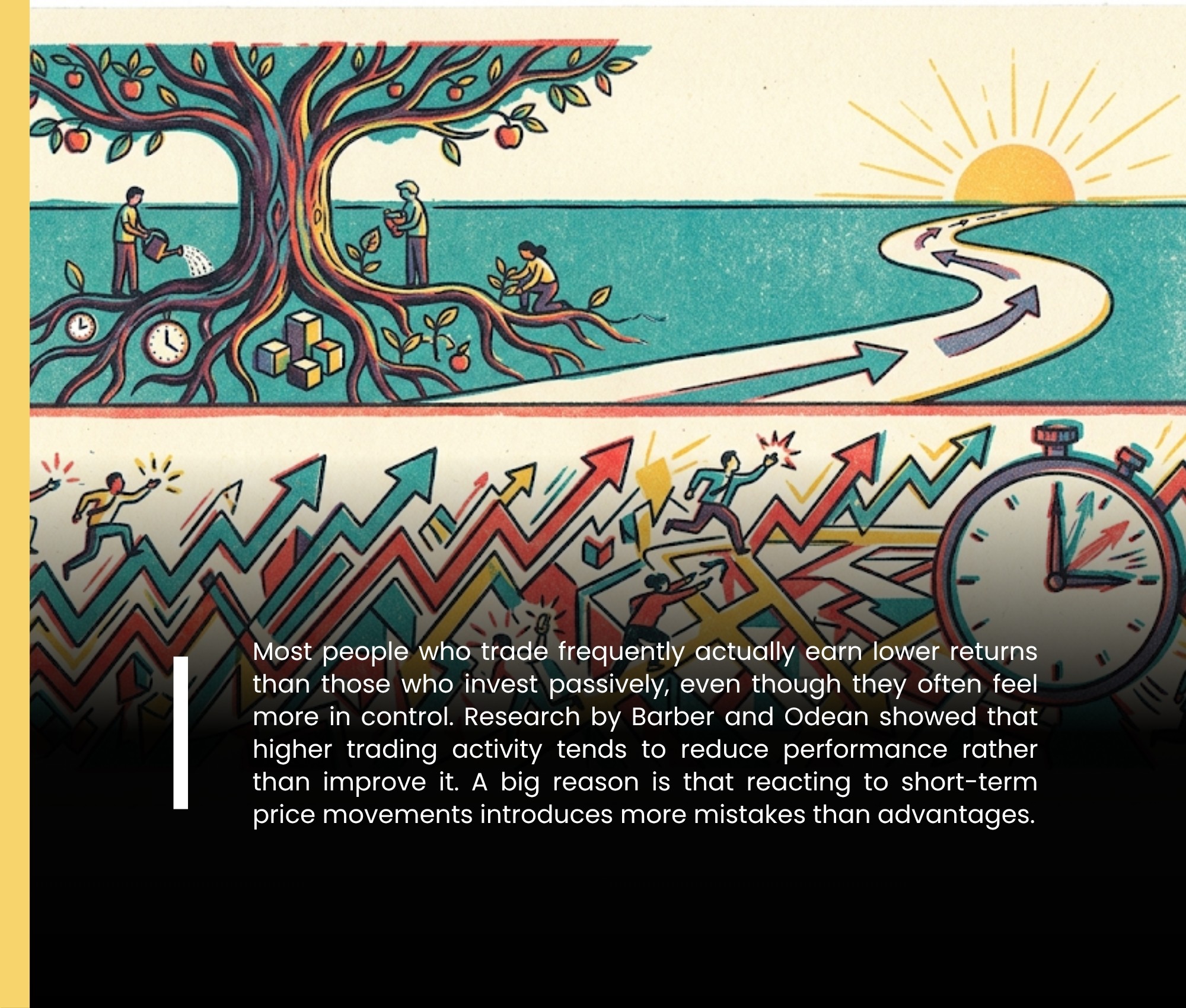
In an age of instant gratification and rapid-fire trading alerts, the ancient wisdom of patient investing often gets drowned out by market noise. Yet, history has repeatedly demonstrated that the most reliable path to substantial wealth creation isn't found in the frenetic world of day trading or market timing, it's discovered in the disciplined practice of buying quality stocks and holding them for years, even decades.
The long-term investment approach isn't merely a conservative strategy; it's a mathematically superior method that harnesses the fundamental forces of capitalism: compound growth, business expansion, and economic progress. When you hold stocks for the long term, you're not just betting on price movements, you're becoming a partial owner in enterprises that generate real products, employ real people, and create genuine value in the economy.
Mathematical Marvel of Compound Returns
Albert Einstein allegedly called compound interest "the eighth wonder of the world," and for good reason. When you hold stocks for extended periods, you unlock the exponential power of returns building upon returns, creating a snowball effect that accelerates wealth accumulation over time.
Consider a practical example: investing $10,000 in a diversified stock portfolio yielding an average annual return of 10% transforms dramatically over different time horizons. After ten years, that investment grows to approximately $25,937. However, extend that holding period to thirty years, and the same initial investment balloons to an impressive $174,494, nearly seven times the ten-year result. This dramatic difference illustrates why time, not timing, is the long-term investor's greatest ally.
The mathematics underlying compound growth becomes even more powerful when you consider dividend reinvestment. Quality companies that consistently pay dividends allow investors to purchase additional shares without deploying new capital. These additional shares then generate their own dividends, creating a self-reinforcing cycle of wealth accumulation. Over decades, reinvested dividends can account for a substantial portion of total returns, historical data suggests that dividend reinvestment has contributed roughly 40% of the total return of the S&P 500 over the past century.
Furthermore, long-term holding periods allow investors to benefit from multiple business cycles. While short-term traders must navigate the choppy waters of quarterly earnings and economic uncertainty, patient investors ride out these temporary fluctuations and capture the overall upward trajectory of successful businesses. A company might stumble during a recession or face temporary headwinds, but over ten or twenty years, well-managed enterprises typically find ways to grow revenue, expand profit margins, and increase shareholder value.
Time Transforms Volatility
Stock market volatility can be terrifying in the short term but becomes increasingly meaningless as your investment horizon extends. This counterintuitive reality stems from a fundamental characteristic of equity markets: while daily and monthly price movements appear chaotic and unpredictable, long-term returns demonstrate remarkable consistency.
Research spanning over a century of market data reveals this pattern clearly. Examining any single year of stock market performance shows wide variance, annual returns can swing from significant losses to spectacular gains. However, when analyzing rolling ten-year periods, the range of outcomes narrows considerably. Extend that analysis to twenty or thirty-year periods, and you find that virtually all time frames have delivered positive real returns, despite encompassing multiple recessions, wars, and financial crises.
This volatility-dampening effect provides long-term investors with a crucial psychological advantage. When your investment horizon spans decades, you can view market corrections and bear markets not as disasters but as temporary setbacks or even opportunities to acquire additional shares at discounted prices. The investor who panics during a 20% market correction and sells at a loss has transformed paper losses into permanent ones. Conversely, the patient investor who maintains conviction through turbulence, or better yet, continues adding to positions, positions themselves to capture the inevitable recovery.
The statistical concept of "volatility drag" further illustrates this principle. In volatile markets, the geometric mean return (what you actually earn) falls below the arithmetic mean return due to the mathematical reality that recovering from a loss requires larger percentage gains. However, this effect diminishes significantly over longer holding periods as returns normalize and compound. By staying invested through multiple market cycles, you smooth out this drag and align your actual returns more closely with the market's long-term expected return.
Tax Advantages
The tax code in most jurisdictions strongly favors patient investors, creating a substantial financial incentive for long-term holding strategies. Understanding and leveraging these tax advantages can significantly enhance your after-tax returns and accelerate wealth accumulation.
In the United States, long-term capital gains, profits from assets held for more than one year, receive preferential tax treatment compared to short-term gains. While short-term capital gains are taxed as ordinary income (potentially at rates exceeding 35% for high earners), long-term capital gains currently face maximum federal rates of just 20%, with many middle-income investors paying 15% or even 0%. This differential can represent savings of 15-20 percentage points, dramatically impacting your net returns over time.
Beyond preferential rates, long-term investing provides the powerful benefit of tax deferral. When you hold stocks without selling, you defer capital gains taxes indefinitely. This deferral allows your entire investment, including the portion that would have gone to taxes, to continue compounding. The longer you defer, the more dramatic this compounding effect becomes. An investor who trades frequently might pay taxes annually on their gains, while a buy-and-hold investor can compound for decades before ever triggering a taxable event.
Consider a practical comparison: Investor A trades actively, generating 15% annual returns but paying 35% in short-term capital gains taxes each year. Investor B employs a buy-and-hold strategy with the same 15% annual returns but defers all taxes until selling after thirty years. After accounting for annual tax drag, Investor A's after-tax return drops to approximately 9.75% annually. Meanwhile, Investor B compounds at the full 15% for three decades before paying a one-time 20% long-term capital gains tax. The difference in final wealth between these two strategies is staggering, Investor B ends up with substantially more money despite identical pre-tax returns.
Additionally, estate planning benefits favor long-term holders. In many jurisdictions, heirs receive a "step-up in basis" when inheriting stocks, potentially eliminating capital gains taxes entirely on appreciation that occurred during the original owner's lifetime. This provision allows families to compound wealth across generations without the friction of taxation, creating dynastic wealth-building potential that active traders can never match.
Minimizing the Silent Wealth Destroyers
While taxes represent an obvious drag on investment returns, transaction costs and management fees can be equally destructive to long-term wealth accumulation, and they're often less visible. Every time you buy or sell a stock, you incur costs that chip away at your returns. For long-term investors who trade infrequently, these costs remain minimal. For active traders, they can devastate performance.
Trading costs come in several forms. Brokerage commissions, though greatly reduced in recent years, still exist for many types of transactions. More significantly, the bid-ask spread, the difference between the price at which you can buy and sell a security, represents a hidden tax on every trade. For less liquid stocks, this spread can be substantial. When you trade frequently, these small costs accumulate into significant wealth destruction over time.
Professional management fees constitute another major cost differential between strategies. Actively managed mutual funds typically charge expense ratios of 1% or more annually, ostensibly to pay for the fund manager's expertise in selecting securities and timing markets. However, decades of research have demonstrated that the vast majority of actively managed funds fail to outperform simple index funds after accounting for fees. By contrast, passive index funds that facilitate buy-and-hold strategies often charge expense ratios below 0.10%, a difference that compounds dramatically over investment lifetimes.
The mathematics of fee impact are sobering. A seemingly modest 1% annual fee might not sound devastating, but consider its long-term impact: over thirty years, a 1% annual fee can reduce your final wealth by approximately 25% compared to a fee-free investment with identical returns. That's a quarter of your lifetime investment gains surrendered not for superior performance but simply for the privilege of active management that typically delivers inferior results.
Long-term investors can minimize these wealth destroyers through simple strategies: selecting low-cost index funds or ETFs, limiting trading frequency, building concentrated positions in quality companies rather than constantly churning their portfolios, and avoiding high-fee actively managed funds. These cost-saving measures might seem small in isolation, but compounded over decades, they represent hundreds of thousands or even millions of dollars retained in your portfolio rather than siphoned off to financial intermediaries.