The Best Indicators for Swing Trading
Posted on
Start Trading
Posted at
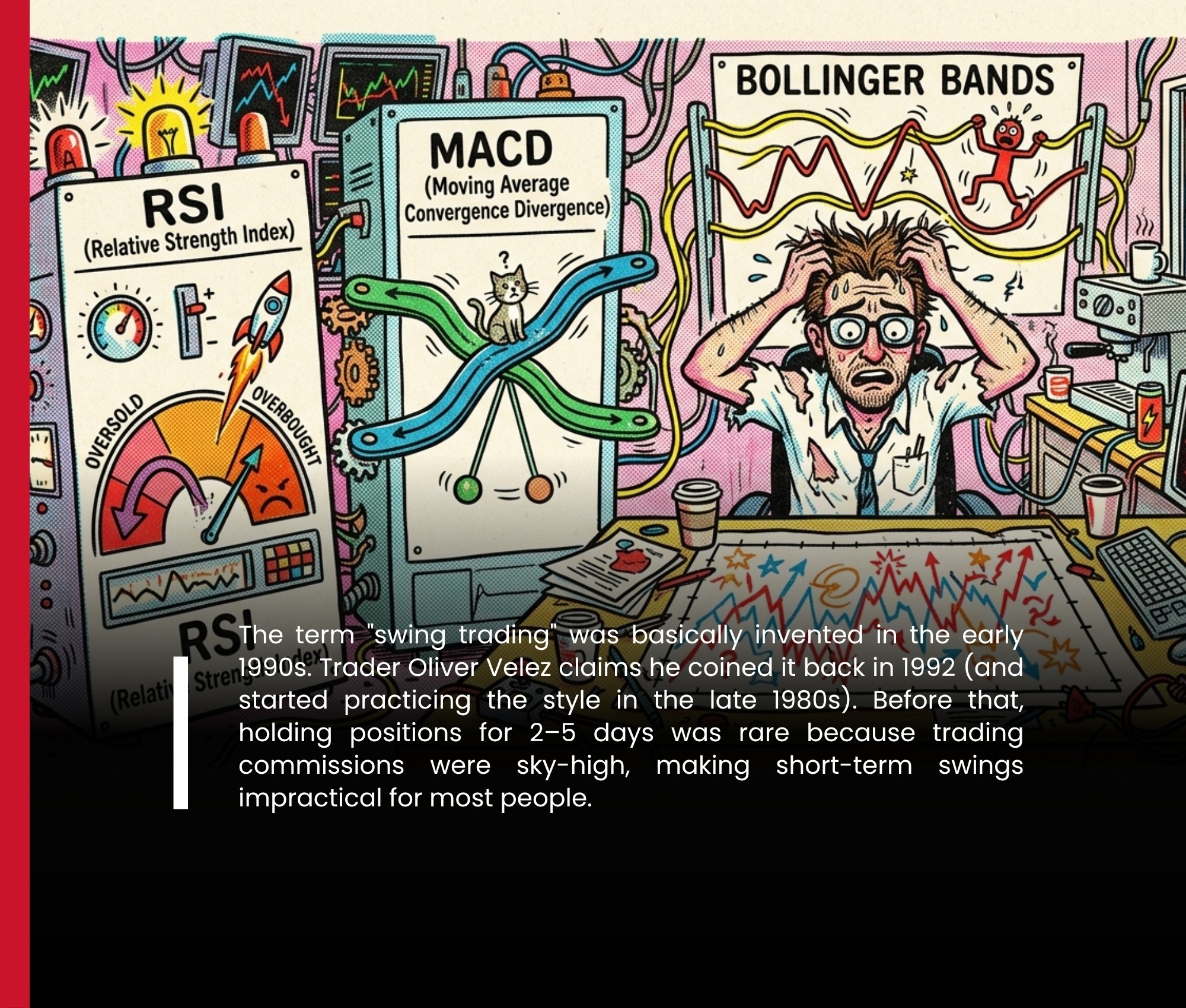
Why Technical Indicators Are Essential for Swing Traders
Price charts tell a story, but without the right analytical framework, most traders read that story too late. Technical indicators act as translators, converting raw price and volume data into actionable signals. For swing traders, the window of opportunity is narrow. A confirmation that arrives two days late is not a confirmation at all, it is a costly entry into an extended move.
Choosing the best indicators for swing trading comes down to understanding four core measurement categories: momentum, which shows how fast price is moving; trend direction, which shows where price is headed over the medium term; volatility, which shows how much room price has to expand; and volume, which confirms whether institutional money is behind the move.
No single indicator works in isolation. The most consistent swing trading systems layer two or three complementary tools to generate high-confidence setups. This article breaks down the six most powerful indicators, explains how each works, and shows how to combine them into a coherent strategy framework.
Key Insight
Academic research and practitioner studies consistently show that combining a momentum oscillator with a trend-following indicator improves win rates by 15-25% compared to using either tool alone. Confluence is the key principle behind every professional swing setup.
The Six Best Indicators for Swing Trading
Below are the six indicators that consistently appear in the toolkits of experienced swing traders. Each serves a distinct role, and each becomes significantly more powerful when combined with at least one other tool from a different category.
Momentum - RSI (14)
Relative Strength Index measures the speed of price changes on a 0-100 scale. Readings below 30 signal oversold conditions, above 70 signal overbought. Divergence between RSI and price is one of the most reliable swing signals available.
★★★★★Swing Rating: Essential
Trend - MACD (12,26,9)
Moving Average Convergence Divergence identifies trend direction and momentum shifts through the relationship between two EMAs. The signal line crossover is the most widely-used swing entry trigger in technical analysis.
★★★★★Swing Rating: Essential
Volatility - Bollinger Bands
Two standard-deviation bands above and below a 20-period moving average create a dynamic price channel. Band squeezes predict volatility expansions. Touches of the outer bands in low-volume conditions signal mean-reversion opportunities.
★★★★☆ Swing Rating: High
Trend - EMA 20/50
The 20-day and 50-day Exponential Moving Averages act as dynamic support and resistance. Price bouncing off a rising 20 EMA in an uptrend is the cleanest, most straightforward swing setup a trader can find on any timeframe.
★★★★☆ Swing Rating: High
Volume - OBV
On-Balance Volume accumulates or subtracts volume based on whether price closes up or down. Rising OBV while price consolidates signals accumulation, often preceding a breakout. It is the most reli
able volume confirmation tool for swing setups.
★★★★☆ Swing Rating: High
Momentum - Stochastic (14,3,3)
A two-line oscillator comparing the closing price to its range over 14 periods. The %K and %D crossover in oversold or overbought territory provides sharp, precise entry timing, particularly effective on 4-hour and daily charts.
★★★☆☆ Swing Rating: Useful
RSI: The Swing Trader's Most Versatile Momentum Tool
The RSI remains the single most commonly cited indicator by professional swing traders for good reason. Its simplicity masks considerable depth. The standard overbought/oversold levels (70/30) are the entry point, not the destination.
The most advanced RSI application for swing trading is bullish divergence: price makes a lower low while RSI makes a higher low. This divergence signals weakening downside momentum and precedes many of the best swing long entries. Bearish divergence, the inverse pattern, works equally well for short setups.
Use RSI 14 on the daily chart as the primary signal.
Confirm RSI oversold readings with a candlestick reversal pattern (hammer, engulfing, doji).
In strong uptrends, treat RSI 40-50 as the new oversold zone rather than 30.
Apply RSI divergence on the 4-hour chart to fine-tune entries identified on the daily chart.
MACD: Capturing the Momentum Shift Before It Becomes Obvious
The MACD is a trend-following momentum indicator. Its primary usefulness for swing traders is not the absolute position of the histogram, but the direction of change. When the histogram starts rising from deeply negative territory, the downtrend is losing steam before price has confirmed a reversal.
The most actionable MACD setup for swing trading is a signal line crossover occurring below the zero line (for longs) or above the zero line (for shorts), combined with a histogram that has been contracting for at least two to three bars. This compression-then-expansion pattern frequently precedes sharp directional moves.
Bollinger Bands: Trading the Squeeze and the Walk
Bollinger Bands provide two distinct swing trading applications. First, the Bollinger Squeeze: when the bands contract to their narrowest width in at least 20 periods, volatility compression is occurring. A breakout in either direction after a squeeze often produces a multi-day or multi-week trending move, ideal for swing traders.
Second, the Band Walk: in a strong trend, price repeatedly touches or hugs the outer band without returning to the centerline. This pattern signals that the trend has genuine momentum and that pullbacks to the 20-period middle band are buying (or selling) opportunities.
Indicator Comparison Table: Core Technical Properties
Indicator | Type | Best Timeframe | Primary Signal | Lagging/Leading | Best Market |
|---|---|---|---|---|---|
RSI (14) | Momentum | Daily, 4H | Divergence, OB/OS | Leading | Trending + Ranging |
MACD (12,26,9) | Trend/Momentum | Daily | Signal crossover | Slightly Lagging | Trending |
Bollinger Bands | Volatility | Daily, Weekly | Squeeze, Band walk | Slightly Lagging | Trending + Ranging |
EMA 20/50 | Trend | Daily, Weekly | Crossover, Bounce | Lagging | Trending |
OBV | Volume | Daily | Divergence vs. price | Leading | Pre-breakout |
Stochastic (14,3,3) | Momentum | 4H, Daily | %K/%D crossover | Leading | Ranging |
Building a Swing Trading System
Knowing individual indicators is necessary but not sufficient. The real edge in swing trading comes from combining indicators that measure different aspects of price behavior, creating a multi-layered confirmation system. Using two momentum oscillators simultaneously, for example, provides little additional information because they measure essentially the same thing.
The three most battle-tested swing trading indicator combinations used by professional traders at Stock Profit Club are described below.
Combination 1: RSI + MACD (Momentum Confluence System)
This is the most widely used swing combination for individual stocks. The RSI identifies the oversold condition on the daily chart, while the MACD signal line crossover confirms that momentum has actually shifted. The requirement for both signals to align simultaneously filters out a significant proportion of false reversals.
✓ Entry Rules: RSI + MACD System
Enter long when RSI drops below 35 and begins turning up, AND MACD histogram stops declining and the signal line crosses above. Place stop-loss below the swing low. Target the next resistance level or a 1:3 risk-reward minimum.
Combination 2: EMA 20 + Bollinger Bands + OBV (Trend Continuation System)
This three-indicator system is designed for stocks that are already in established uptrends. The 20 EMA defines the trend. Bollinger Bands identify when price has pulled back to an area of potential support. OBV confirms that institutional accumulation is ongoing. When all three align, the probability of a successful continuation swing is materially higher than any single signal alone.
The 20 EMA must be pointing upward (confirming the trend direction).
Price pulls back to touch or slightly breach the 20 EMA (creating the entry opportunity).
The Bollinger midline (also a 20-period MA) acts as additional dynamic support at the same level.
OBV should be holding above its recent low or making a new high (confirming accumulation).
Enter on the first bullish close back above the 20 EMA after the pullback.
Combination 3: Stochastic + Bollinger Bands (Mean Reversion System)
This combination works best in ranging markets or during consolidation phases. The Stochastic oscillator identifies when price has moved to an extreme within the range. Bollinger Bands confirm when that extreme coincides with the outer band, adding a statistical dimension. Together, they produce high-probability mean-reversion trades back to the center of the range.
Risk Management and Position Sizing for Swing Traders
The best indicators for swing trading are useless without a disciplined risk management framework. Indicator signals identify where to enter a trade. Risk management determines how much to risk and when to exit. No trading system survives a series of maximum-size losing trades, regardless of its theoretical win rate.
The core principle is simple: risk a fixed percentage of capital on each trade, and ensure that the potential reward is at least two to three times the amount risked before entering any position. This is the minimum viable risk-reward threshold for a sustainable swing trading operation.
Risk-Reward Scenario Table
Account Size | Risk Per Trade (1%) | Stop-Loss Distance | Position Size | Target (3:1 R:R) | Net Profit if Target Hit |
|---|---|---|---|---|---|
$10,000 | $100 | 3% | $3,333 | 9% gain | +$300 |
$25,000 | $250 | 3% | $8,333 | 9% gain | +$750 |
$50,000 | $500 | 4% | $12,500 | 12% gain | +$1,500 |
$100,000 | $1,000 | 4% | $25,000 | 12% gain | +$3,000 |
$250,000 | $2,500 | 5% | $50,000 | 15% gain | +$7,500 |
Note: The position size is calculated by dividing the dollar risk by the stop-loss percentage. A $100 risk on a stock with a 3% stop requires a $3,333 position. This keeps losses controlled while allowing full participation in successful swings.
Swing Trading Risk Factor Table
Risk Factor | Description | Severity | Mitigation Strategy |
|---|---|---|---|
False Signal Risk | Indicator crossovers that fail to produce the expected move | Medium | Require confluence of 2+ indicators before entry |
Gap Risk | Overnight or weekend gaps past stop-loss levels | High | Reduce position size ahead of earnings or macro events |
Trend Reversal Risk | A broader trend reversal invalidates the swing setup | High | Monitor the weekly chart trend before entering daily setups |
Liquidity Risk | Unable to exit at desired price in thinly traded stocks | Medium | Trade only stocks with average daily volume above 500K shares |
Overtrading Risk | Taking too many setups simultaneously, diluting focus | Medium | Cap open swing positions at 5-8 at any one time |
Indicator Lag Risk | Entering too late because lagging indicators confirm too slowly | Medium | Combine lagging trend tools with leading oscillators (RSI, Stochastic) |
Conclusion: Building Your Swing Trading Edge
Swing trading rewards patience, preparation, and systematic thinking. The best indicators for swing trading are not the most exotic or the most complex, they are the ones a trader understands deeply enough to trust under pressure. RSI and MACD form the core of most professional swing systems because they measure momentum and trend direction from complementary angles. Bollinger Bands add a volatility dimension that sharpens entry timing and targets. EMAs define the trend structure that makes each setup valid or invalid. OBV and Stochastic complete the picture with volume confirmation and precise oscillator-based timing.
The critical next step is not collecting more indicators, it is practicing a smaller number of setups until pattern recognition becomes automatic. Backtesting each combination on at least 50 historical examples before trading it live gives traders the statistical foundation to trust the system during its inevitable losing streaks.
Most importantly, indicators provide signals, not certainty. Every swing trade is a probability exercise. Managing risk on every trade, scaling into positions deliberately, and honoring stop-losses consistently are what separate profitable swing traders from those who simply generate transaction costs.
Strategic Investor Takeaway
The most durable swing trading edge comes from the combination of RSI divergence (leading, momentum), MACD crossover (confirming, trend), and EMA structure (filtering, trend direction). This three-tool system is backtestable, rules-based, and applicable across any liquid equity or ETF. Begin by mastering RSI divergence alone. Add MACD confirmation once you can consistently identify divergence setups. Layer EMA structure last to filter out setups that are counter-trend.
Always define your maximum risk before entry. In any setup where the risk-to-reward ratio is below 1:2, pass and wait for the next opportunity. Markets generate new setups daily. Capital preservation is the first rule of a long trading career.
For deeper analysis on specific stocks and real-time swing trade alerts, explore the full research library at StockProfitClub.com.