Breakout Trading Using Technical Analysis
Posted on
Start Trading
Posted at
What Is Breakout Trading?
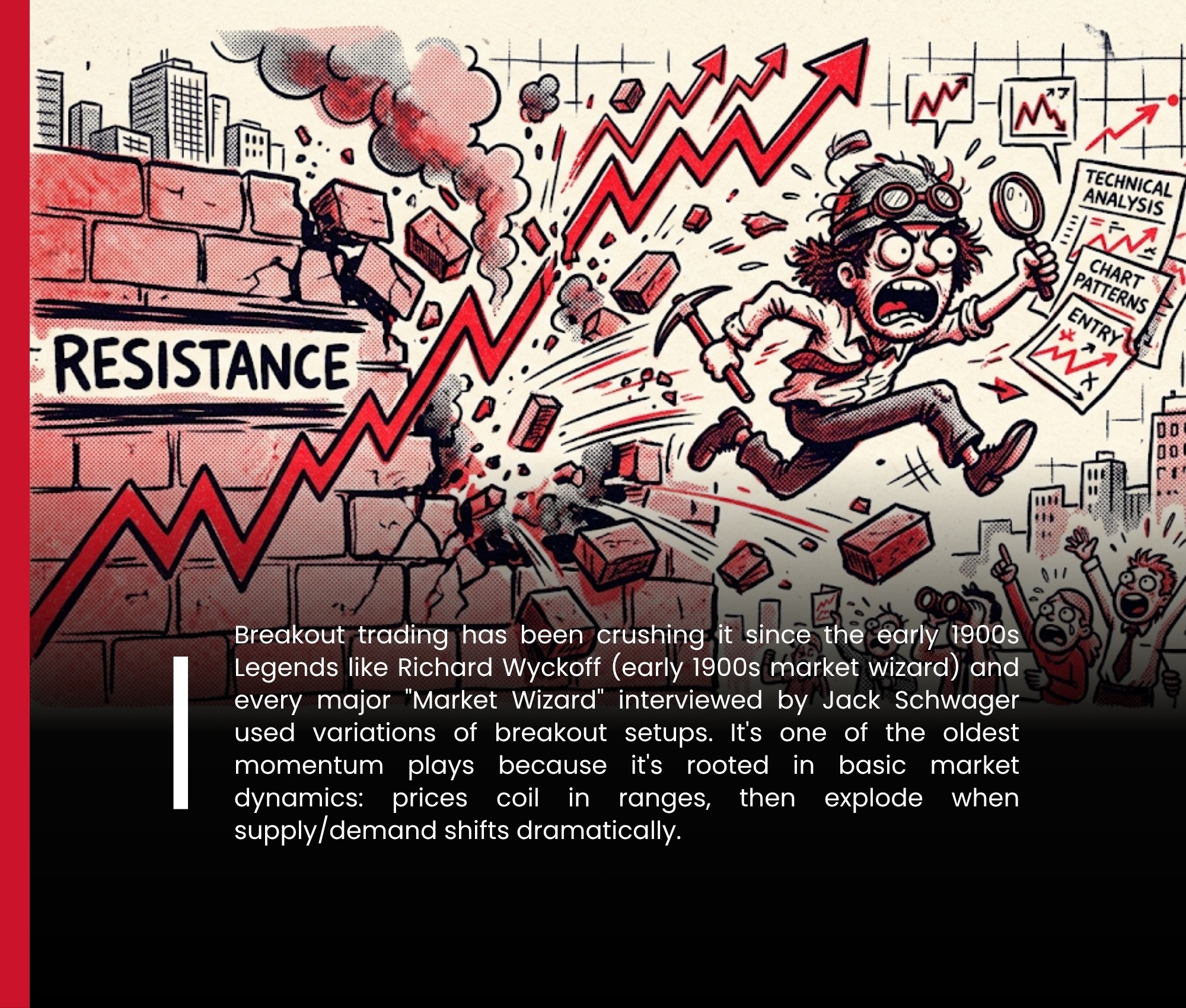
Breakout trading is a momentum-based strategy where an investor enters a position the moment a stock's price moves decisively above a key resistance level, or below a key support level, on above-average volume. The core premise is simple: when price breaks out of a defined trading range, it tends to continue moving in the direction of the breakout, often sharply and quickly.
Unlike buy-and-hold investing, breakout trading is an active strategy that relies heavily on technical analysis to identify the precise moment when supply and demand dynamics shift in favor of a strong directional move. It is used by retail traders, hedge funds, and institutional desks alike, making it one of the most widely practiced approaches in modern markets.
This guide from Stock Profit Club breaks down the full methodology: from identifying the setup, to confirming the entry, to managing the trade like a professional.
The Technical Foundation of Breakout Trading
Understanding breakout trading starts with understanding the market structure that creates the opportunity.
Support and Resistance: The Battleground
Every breakout begins at a level where price has historically struggled to move beyond. These are called resistance levels (above current price) and support levels (below current price). The longer a stock has tested a level and failed to break it, the more significant that level becomes, and the more explosive the eventual breakout tends to be.
Key reasons resistance levels form:
Large institutional sell orders stacked at a price ceiling
Prior highs where sellers previously entered in force
Psychological round numbers (like $100, $200, $500)
Long-term moving averages acting as dynamic resistance
When a stock finally clears one of these levels on heavy volume, it signals that buyers have absorbed all available sell-side supply, and price is free to move higher.
Chart Patterns That Precede Breakouts
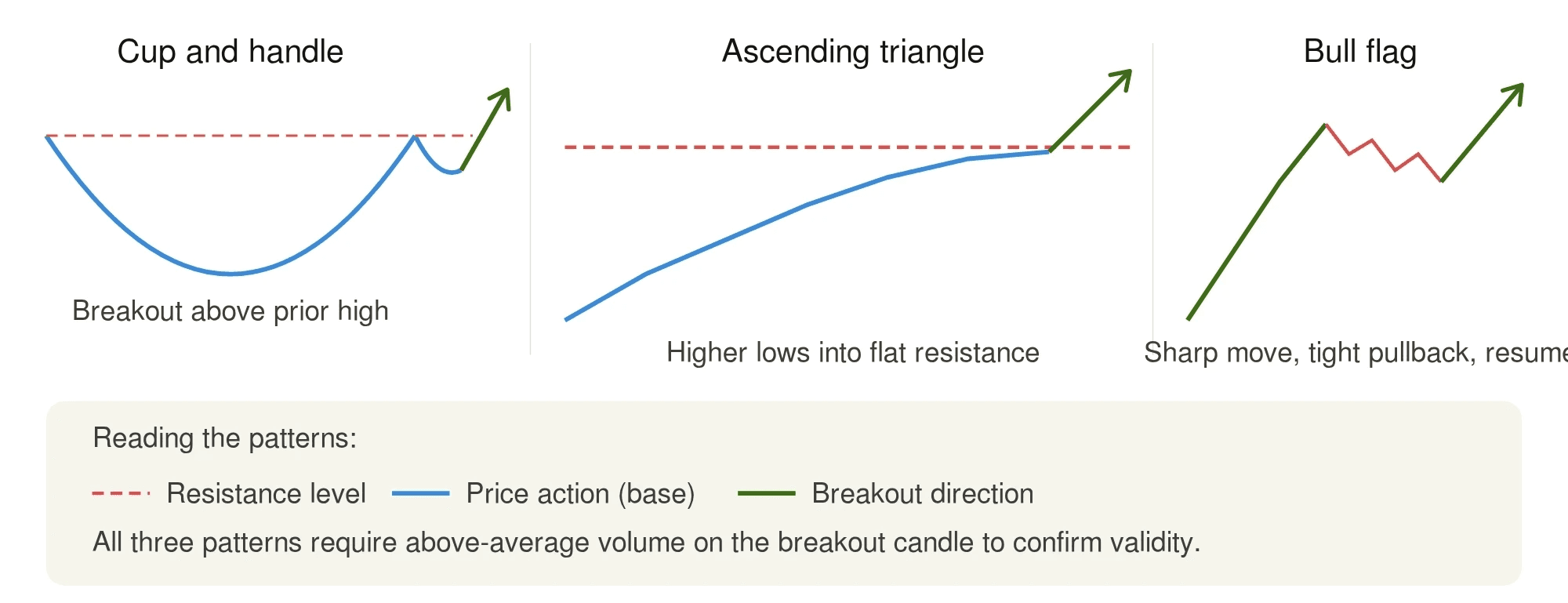
Breakouts rarely happen out of nowhere. They almost always emerge from a recognizable consolidation pattern. The most reliable include:
Cup and Handle: A rounded base followed by a short pullback, then breakout. Often seen in high-quality growth stocks.
Flat Base: Price moves sideways in a tight range after a prior uptrend. One of the tightest and most reliable patterns.
Ascending Triangle: A series of higher lows pressing against a flat resistance ceiling. Buyers are gaining strength.
Bull Flag: A sharp move up followed by a brief, low-volume pullback. The flag "waves" before the next leg up.
Volatility Contraction Pattern (VCP): Price contracts in progressively tighter ranges before a powerful breakout. Used extensively by Mark Minervini-style traders.
The Role of Moving Averages
Moving averages provide dynamic context around any breakout:
The 10-week / 50-day moving average is a key line of support for breakout stocks in uptrends.
The 200-day moving average separates long-term bullish and bearish phases.
A breakout occurring above both moving averages, while price itself is in a longer-term uptrend, dramatically increases probability of follow-through.
Rule of thumb: Trade breakouts in the direction of the dominant trend. A breakout above resistance in a stock that is already above its 200-day moving average is significantly higher probability than one occurring in a downtrend.
Confirming a Valid Breakout, Volume, Relative Strength, and Timing
Not every price push above resistance is a genuine breakout. Many are false breakouts, also called "fakeouts," that reverse quickly and trap impatient buyers. Confirmation is everything in breakout trading.
Volume: The Single Most Important Confirmation Signal
Volume is the fuel behind any meaningful price move. A breakout on low or average volume is a warning sign. A breakout on significantly above-average volume signals institutional conviction.
What to look for:
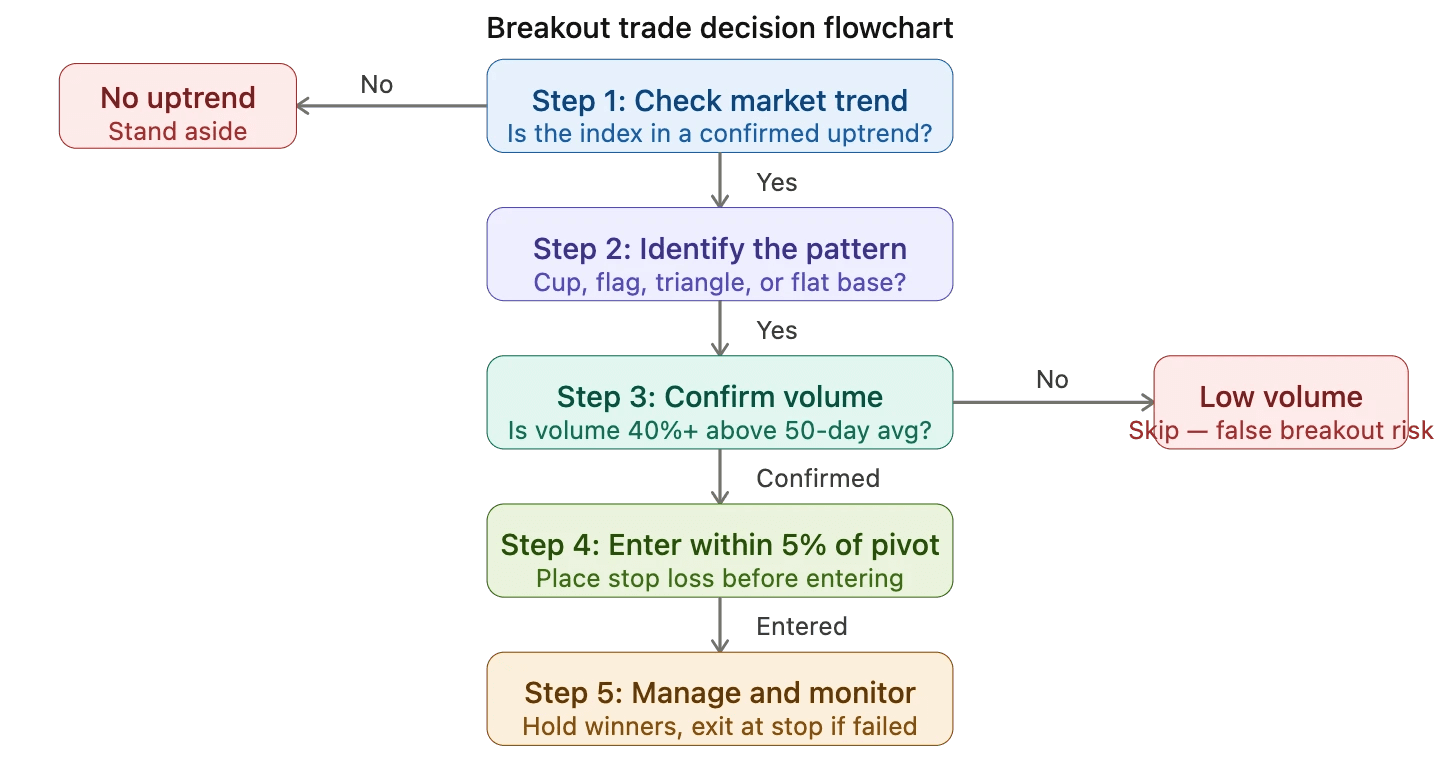
Volume on the breakout day should ideally be 40% to 300% above the 50-day average volume.
Volume should expand as price approaches the breakout point, not suddenly spike from nowhere.
In the days following the breakout, volume should remain elevated, confirming ongoing accumulation.
The practical logic: institutions (mutual funds, pension funds, hedge funds) cannot buy millions of shares without leaving a volume footprint. Heavy breakout volume is evidence that "smart money" is entering the position alongside you.
Relative Strength: Is the Stock Leading the Market?
A strong breakout candidate should be outperforming the broader market before the breakout occurs. This is measured by the Relative Strength (RS) Rating (popularized by Investor's Business Daily), which compares a stock's 12-month price performance against all other stocks.
Top-performing breakout stocks typically have an RS Rating of 80 or above before they break out. Stocks with high relative strength are already showing that institutional demand is outpacing supply.
Timing the Market Cycle
Even the best technical setup fails in a deteriorating market. Breakout trading has a much higher success rate when:
The major indices (S&P 500, Nasdaq) are in a confirmed uptrend.
The number of stocks making new 52-week highs is expanding.
Sector rotation is flowing into growth or momentum sectors.
Breakout traders should significantly reduce or eliminate long positions when the market enters a distribution phase or correction. Capital preservation is a strategy.
Building a Breakout Trading Strategy, Entry, Exit, and Risk
Entry: Where to Buy
The ideal entry point is within 5% of the pivot point (the high of the base or handle). Chasing a stock that has already run 10-20% past its breakout is a high-risk, low-reward proposition.
Common entry approaches:
At the breakout: Buy as price crosses the pivot on heavy volume. Highest risk, highest potential reward.
On the first pullback to the breakout level: More conservative. Wait for price to retest former resistance as new support.
On a gap up: Some of the most powerful breakouts occur on earnings gaps. These can be bought near the top of the gap day's range if volume confirms.
Stop Loss: Protecting Capital
Every breakout trade must have a predefined stop loss before entry. This is not optional. It is the mechanism that separates disciplined trading from gambling.
Common stop placement:
Just below the handle low (for cup-and-handle setups)
Just below the 10-day or 21-day exponential moving average
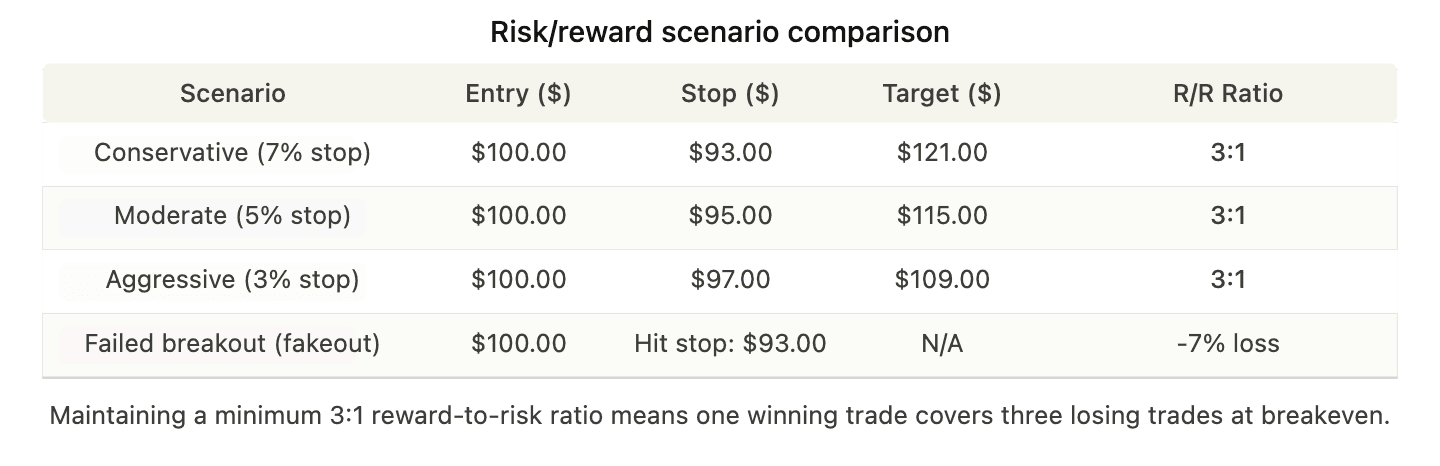
7-8% below entry (a standard used by many CANSLIM practitioners)
If price closes below the stop loss, exit the position without hesitation. The market has told you the setup has failed.
Position Sizing: Controlling Portfolio Risk
Professional traders never risk more than 1-2% of total portfolio capital on a single trade. Position size is calculated based on the distance between entry and stop loss.
Formula:
Position Size = (Portfolio Value × Risk Per Trade) ÷ (Entry Price − Stop Loss Price)
Example: $100,000 portfolio, 1% risk ($1,000), entry at $50, stop at $46.50. Risk per share = $3.50. Position size = $1,000 ÷ $3.50 = 285 shares.
Profit Targets and Holding Rules
Taking profits too early is one of the most common breakout trading mistakes. The best stocks from great bases can run 100-400% or more. Rules to hold through normal volatility:
Do not sell on a normal pullback to the 10-week moving average (the first 1-2 times).
Start trimming if a stock rises 20-25% from the pivot in less than three weeks (sign of exceptional strength, can hold more).
Sell the entire position if the stock undercuts its 10-week moving average on heavy volume.
Quantitative Framework, Risk/Reward Tables and Performance Data
Good breakout trading is systematic, not emotional. Here is the quantitative framework professional traders use to evaluate every setup.
Breakout Setup Evaluation Checklist
Criterion | Minimum Threshold | Ideal Standard |
|---|---|---|
Volume on breakout day | 40% above 50-day avg | 100%+ above 50-day avg |
Distance from pivot | Within 5% | Within 2-3% |
Relative Strength Rating | 70 or above | 85 or above |
Base depth (correction) | Less than 35% | 15-25% |
Number of weeks in base | At least 5 weeks | 7-15 weeks |
Market trend (index) | Confirmed uptrend | Leading sector uptrend |
EPS growth (last quarter) | 25%+ year-over-year | 50%+ or accelerating |
Revenue growth | 15%+ year-over-year | 25%+ or accelerating |
Risk/Reward Scenario Table
Win Rate vs. Profit Factor Analysis
Understanding the math behind breakout trading removes the emotional element. A trader does not need to win 70% of trades to be profitable if the losses are small and the wins are large.
Win Rate | Avg Win | Avg Loss | Profit Factor | Expected Outcome |
|---|---|---|---|---|
40% | 20% | 7% | 1.90x | Profitable |
33% | 25% | 7% | 1.78x | Profitable |
50% | 20% | 7% | 2.86x | Highly Profitable |
25% | 35% | 7% | 1.67x | Breakeven range |
Profit Factor = (Win Rate × Avg Win) ÷ (Loss Rate × Avg Loss)
Any profit factor above 1.0 is profitable over time. Above 2.0 is considered excellent. The best breakout traders consistently achieve profit factors of 2.5 to 4.0 over large sample sizes.
Common Mistakes, Risk Factors, and How to Avoid False Breakouts
Even technically sound breakout strategies carry real risks. Understanding these risks in advance is the difference between a disciplined trader and an overconfident one.
The Biggest Mistakes Breakout Traders Make
1. Chasing extended breakouts. Buying a stock that has already moved 15-20% past its pivot dramatically worsens the risk/reward ratio. The best entries are within 2-5% of the pivot.
2. Ignoring market conditions. The most beautiful chart pattern fails in a bear market. Always check the market trend before entering breakout positions.
3. Holding through stop losses. Hoping a position recovers is not a strategy. Stop losses must be respected. One large loss can erase weeks of gains.
4. Overconcentration. Putting too much capital into a single breakout trade exposes the portfolio to catastrophic loss if the trade fails.
5. Buying on low volume. This is the clearest warning sign. If the market does not confirm the breakout with volume, the probability of a false breakout rises sharply.
6. Selling winners too early. Many traders take a 5-10% gain on a breakout that could have delivered 50-100%. The discipline to hold is as important as the discipline to sell.
False Breakout Risk Table
Risk Factor | Likelihood | Impact | Mitigation |
|---|---|---|---|
Low volume breakout | High | Medium | Require 40%+ above avg volume |
Weak market environment | High | High | Wait for confirmed market uptrend |
Buying extended (10%+ past pivot) | Medium | High | Stick to 5% max from pivot |
Earnings event within 2-3 weeks | Medium | Very High | Avoid or reduce position size |
Sector in downtrend | Medium | High | Only trade leading sectors |
Shallow base (less than 5 weeks) | Low-Medium | Medium | Require 5+ week base minimum |
Stop loss not placed | Low (behavioral) | Catastrophic | Always place stop before entering |
How to Distinguish a True Breakout from a False One
A few additional filters help separate genuine breakouts from traps:
Price closes above the resistance level for at least 2-3 consecutive sessions, not just intraday.
The base was formed on declining volume, meaning selling pressure dried up before the breakout.
No earnings announcement within the next 2-3 weeks (earnings events introduce binary risk).
The broad market is in rally mode or at least not in active distribution.
The stock's industry group is ranked in the top 40% of all industry groups by performance.
If a breakout reverses and price falls back below the pivot on heavy volume within the first two weeks, exit immediately. This is the clearest sign of a failed breakout.
Ready to sharpen your edge as an investor? Explore in-depth technical analysis guides, stock breakdowns, and actionable trading strategies at Stock Profit Club. Whether you are a beginner or an experienced market participant, the tools and insights you need to trade with confidence are waiting for you.